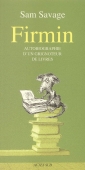
Autobiographie d'un grignoteur de livres, Firmin raconte l'histoire d'un rongeur érudit qui a vu le jour dans les sous-sols d'une librairie de Scollay Square, vieux quartier en péril du Boston des années 1960. Plein d'appétit pour les mots, épris de nourritures spirituelles autant que terrestres, Firmin ne peut communiquer tous ses coups de coeur ni exprimer ses détresses, et voit avec révolte se déliter sa race comme son quartier, cernés par l'incompréhension des hommes et par les mécanismes du profit. Mais la rencontre avec un romancier marginal le sauve du pessimisme ambiant. Superbe hommage aux valeurs de l'écrit et aux singularités de toutes espèces, l'aventure de Firmin est aussi un fabuleux trait d'union entre littérature, exclusion et résistance.
« Firmin, le rat que Walt Disney aurait inventé s'il avait été Borges. Si lire est ton plaisir et ton destin, ce livre a été écrit pour toi. » (Alessandro Baricco)

Rudolf Herrnstadt est considéré comme l'un des pères fondateurs de la RDA. Il fut aussi un homme de presse incontournable dans l'Allemagne des années 1930-1940, participant notamment à la création du Berliner Zeitung. Il commença sa carrière de journaliste dès 1924, fut envoyé comme correspondant à Prague, Varsovie puis Moscou, et revint à Berlin où il entra en contact avec l'Armée rouge. Il adhéra au parti communiste allemand en 1950 avant d'en être exclu en 1954.
Irina Liebmann retrace le parcours de cet homme, son père, qui, partout, s'efforça de défendre la démocratie malmenée en Europe.
Plus qu'une biographie, Berlin-Moscou-Berlin est une véritable enquête qui offre un portrait détaillé de tout un pan de l'histoire du XXe siècle.
«Le père d'Irina Liebmann a vécu trois vies : il fut un excellent journaliste, un espion et le 'Citizen Kane' de l'Allemagne de l'Est. Sa fille a désormais écrit sa biographie : une brillante liaison entre sa propre histoire, celle du monde et celle de l'Allemagne.» (Die Literarische Welt)
«Berlin-Moscou-Berlin se lit le souffle coupé.» (Berliner Zeitung)

«Je ne suis pas historien et Human Smoke n'est en rien un livre d'histoire traditionnel. Je l'ai écrit car j'ai réalisé que je ne comprenais pas la Seconde guerre mondiale - la comprendre non pas dans le sens d'arriver à formuler des théories mécaniques qui en détermineraient les causes, mais dans le sens plus modeste d'avancer à tâtons, avec compassion, dans son énormité. [...] Le livre s'achève le 31 décembre 1941 - juste avant que les dernières barrières ne soient levées, quand la civilisation était au bord du gouffre. Comment en sommes-nous arrivés là ?
J'ai fractionné le temps en petits morceaux et en images. Je n'en tire aucune conclusion. [...] Mais j'ai choisi ces instants afin de poser une question qui doit être posée. Notre décision de combattre de la façon dont nous avons combattu, par des bombardements nocturnes et des blocus alimentaires, a-t-elle vraiment aidé ceux qui avaient besoin d'aide ?
J'espère que ce livre ajoutera une confusion enrichissante à votre connaissance de base de la 'bonne guerre'». Nicholson Baker

«Updike & moi est un 'texte d'écrivain', une introspection portant à la fois sur ce qui fait écrire et ce qui en empêche, sur les plaisirs rares que peut apporter ce drôle de boulot et sur le bon gros paquet, bien plus encombrant, de doutes, d'incertitudes, de bourdes et d'inaccomplissement qui viennent avec. [...]
C'est un texte drôle et sans complaisance, tant Baker sait s'y moquer d'Updike, de lui-même et de toutes les vanités littéraires. C'est un texte gratifiant, tant il sait, aux moments les plus inattendus, ménager ses surprises. C'est un texte émouvant quand il évoque en parallèle les relations entre Updike et sa mère et entre Baker et la sienne. [...] C'est enfin un texte passionnant, qui brosse un portrait partial, partiel mais fascinant de l'Amérique littéraire de la deuxième moitié du XXe siècle.
[...] S'il est une seule raison de lire ce petit livre paradoxal, elle tient tout entière dans une phrase que Baker y sème, l'air de rien, avec une modestie sincère, et qui résume à elle seule son éthique professionnelle et le défi qu'il se lance à chaque livre : 'La tâche d'un écrivain est simplement de régaler et d'instruire du mieux qu'il peut.'» Martin Winckler

Described by the New York Times as 'an original and remarkable genius', Kazuo Ishiguro is the author of six novels, including Never Let Go and The Remains of the Day.
Now in Nocturnes, a sublime story cycle, he explores ideas of love, music and the passing of time. From the piazzas of Italy to the Malvern Hills, a London flat to the 'hush-hush floor' of an exclusive Hollywood hotel, the characters we encounter range from young dreamers to cafe musicians to faded stars, all of them at some moment of reckoning.
Gentle, intimate and witty, this quintet is marked by a haunting theme : the struggle to keep alive a sense of life's romance, even as one gets older, relationships founder and youthful hopes recede.

As a novelist, Graham Swift delights in the possibilities of the human voice, imagining his way into the minds and hearts of an extraordinary range of characters. In Making an Elephant, his first ever work of non-fiction, the voice is his own. As generous in its scope as it is acute in its observations, this highly personal book is a singular and open-spirited account of a writer's life.
Swift brings together a richly varied selection of essays, portraits, poetry, and interviews, full of insights into his passions and motivations, and wise about the friends, family, and other writers who have mattered to him over the years. Kazuo Ishiguro advises on how to choose a guitar, Salman Rushdie arrives for Christmas under guard, and Ted Hughes shares the secrets of a Devon river. There are private moments, too, with long-deal writers, as well as musings on history and memory that readers of Swift's novels will recognize and love.
A journey through place and time, Making an Elephant is a book of encounters, between a son and his father, between an author and his younger selves, between writer and reader, and between friends. It brims with charm and candour, and tells of alertness to experience and a true engagement with words, in short, with what it means to feel that writing and reading are an essential part of living.
Graham Swift was born in 1919 and is the author of eight acclaimed novels and a collection of short stories. With Waterland he won the Guardian Fiction Prize (1983), and with Last Orders the Booker Prize (1986). Both novels have since been made into films. Graham Swift's work has appeared in over thirty languages.

How Fiction Works is a scintillating and searching study of the main elements of fiction, such as narrative, detail, characterisation, dialogue, realism and style. In his first full-length book of criticism, one of the most prominent critics of our time takes the machinery of story-telling apart to ask a series of fundamental questions : What do we mean when we say we 'know' a character ? What constitutes a 'telling' detail ? When is a metaphor successful ? Why do most endings of novels disappoint ?
With examples ranging from Homer to Beatrix Potter, and the Bible to John le Carré, the result is both a study of the techniques of fiction-making and an alternative history of the novel. Playful and profound, it will be enlightening to writers, readers and anyone interested in what happens on the page.

From a rising young British novelist comes an artful meditation on love and life in contemporary London.
When David Pinner introduces his former teacher, the American artist Ruth Marks, to his friend and flatmate James Glover, he unwittingly sets in place a love triangle loaded with tension, guilt and heartbreak. As David plays reluctant witness (and more) to James and Ruth's escalating love affair, he must come to terms with his own blighted emotional life.
Set in the London art scene awash with new money and intellectual pretension, in the sleek galleries and restaurants of a Britannia resurgent with cultural and economic power, Nick Laird's insightful and drolly satirical novel vividly portrays three people whose world gradually fractures along the fault lines of desire, truth and jealousy. With wit and compassion, Laird explores the very nature of contemporary romance, among damaged souls whose hearts and heads never quite line up long enough for them to achieve true happiness.

The secret history of novelists is often a history of exile and tourism - a history of language learning.
Like the story of Gustave Flaubert and Juliet Herbert, it is a history of loss and mistakes.
Flaubert's niece was taught by an English governess : Juliet Herbert. As Flaubert finished Madame Bovary, Miss Herbert translated his novel into English. But this translation has since been lost. No photographs of Miss Herbert survive, either.
Translation, and emigration, is the way into a new history of the novel - a history of loss, of mistakes. We assume that we can read novels in translation. We also assume that style does not translate. But the history of the novel is the history of style.
Miss Herbert solves this conundrum.
The book travels from Rio de Janeiro to Prague, from Moscow to London, from Trieste to Paris, from Warsaw to New York. On its zigzagging flight, it reinvents our ideas of style, and translation - introducing new theories of jet lag, of the time difference. Miss Herbert finds problems with accurate translations, and praises imperfect ones. It dismisses history and politics, replacing them with the fun of literary games.
This is not a novel, but an inside-out novel - with novelists as characters.
But Miss Herbert is not just a book. It demonstrates a new way of reading internationally. It is a project, a book of tricks - complete with maps, illustrations, and a variety of helpful diagrams. And it comes with a companion, a slim appendix : 'Mademoiselle O', a story by Vladimir Nabokov, written in French, about his own governess, never before translated into English.
Miss Herbert is a bedside travel book, a comprehensive city break : the most original and most stylish beach read.

' On ne voyage que pour raconter ' nous a soufflé Pascal, Blaise, peu joué sur Broadway. On voyage aussi pour oublier, rajoute Perelman, qui connut peu Pascal et aurait aimé être joué à Broadway. Dont acte avec ce Tous à l'ouest ! qui narre par le menu la saga touffue et ébouriffante d'une paire d'entertainers new-yorkais, Hirschfeld et Perelman, partis ' globe-trotter ' all around ze weurlde pour noyer dans le mouvement l'échec d'une comédie musicale. On ouvre avec un stage survie dans les décors de Hollywood, on embarque à San Francisco, à bord du Marine Flier, direction l'Orient extrême, ses fragrances, son mystère. En attendant la ' troublante et insondable Asie ', Perelman se fait plumer aux dés. Ils abordent à Qinhuangdao, sa rade, ses échoppes, Shanghai suit, sa foule, son dollar dévalué, puis Hong Kong pour un rencontre avec Bao Daile déconfit. Le lecteur se retrouvera ensuite à un pique-nique au tapioca avec un potentat malais et à visiter - chaque tronc a son petit nom - une plantation d'hévéas ; à Bangkok, Perelman manque d'acheter un éléphanteau d'appartement : échec. Et pourquoi vous dévoiler les passionnantes péripéties survenues à Penang, Ceylan, Bombay, devant le Taj Mahal, Agra, alors que vous n'avez pas encore pris l'engagement d'offrir le volume à tous vos proches ? J'agirais de même avec l'escapade au Caire, Pompéi, le Negresco, Paris ou Londres. Sachez seulement que Tous à l'ouest résulte d'un mix hautement salubre entre Phileas Fogg et les Marx Brothers, le planning de l'un revu par la capacité de gestion des catastrophes des autres, et Tous à l'ouest définit autant le mental de l'auteur qu'il sert de titre à son livre. Et maintenant : tous en scène !